

A deep dive into swing decisions by the Mets Saturday afternoon

The following is an exchange from Saturday’s Game Chatter, lightly edited for typos/grammar
Me
Bichette watches a strike for the first pitch and then swings at the next two pitches out of the zone
And grounds out
Me
The guy can’t wait to swing and then watches a first-pitch strike. I don’t get it
Chris Flanders
There’s a story in the watch Ks swing at balls issue
Me
I agree. Just worry how long it would take to do it right
Yeah - need to rewatch a game or start with a new game
So, it turned out not to be too hard to do it. Statcast has a pitch-by-pitch graphic, complete with a strike zone box. Now, the strike zone box isn’t necessarily perfect. But I used that to determine if a pitch that was swung at was inside the strike zone. Any ball that touched any part of the strike zone box was considered a strike. Here’s an example of the Statcast graphic worked off here:
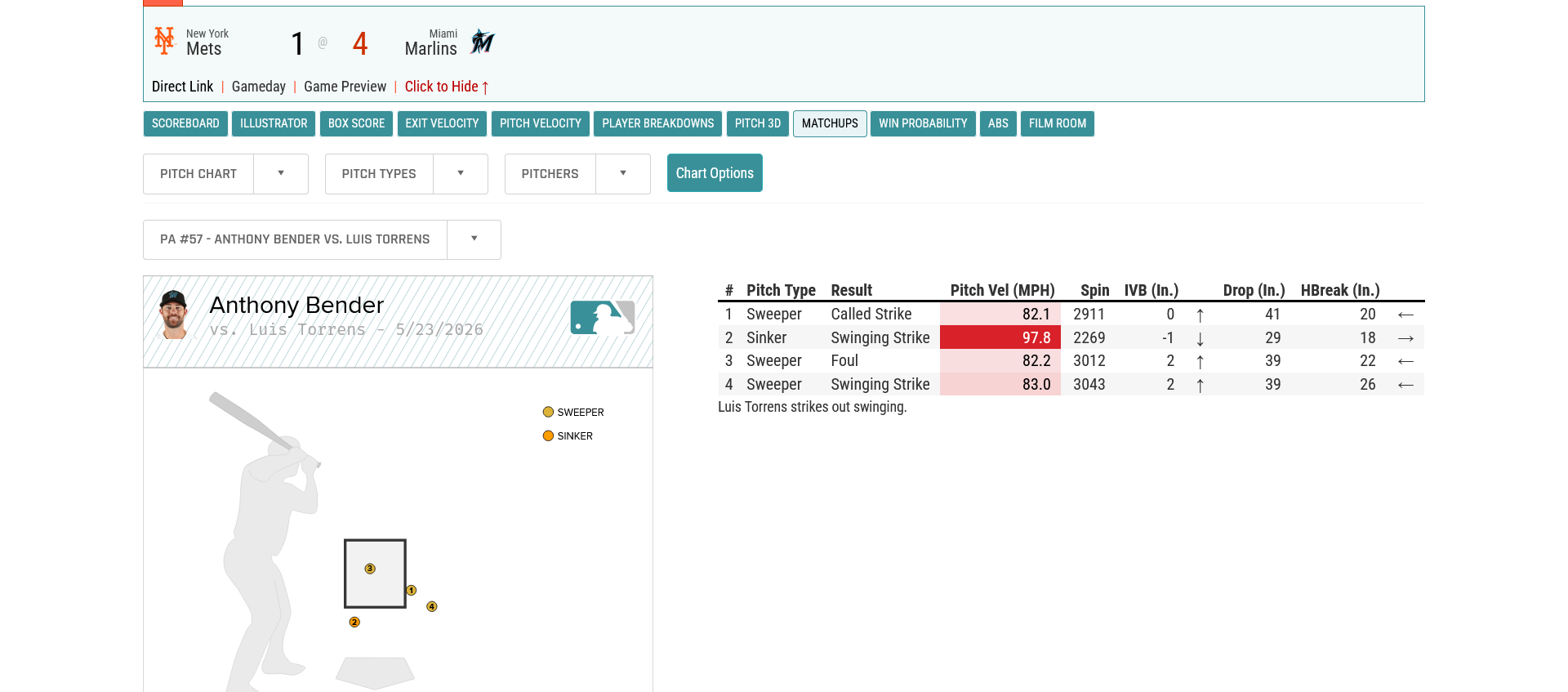
First pitch – called strike
Second pitch – ball swing
Third pith – strike swing
Fourth pitch – ball swing
So, in this PA, Luis Torrens watched one strike and swung at two balls outside of the strike zone. This was done for all 127 pitches the Mets faced in the game and here are the results:
Ball Taken – 46
Ball Swing – 22
Strike Called – 29
Strike Swing – 30
It seems that among 127 pitches, 22 swings at balls outside of the strike zone is a lot, as is 29 strikes that the batter takes. Yet we need context. Here are the MLB totals for all games thru Saturday:
O-Swing% - 32.5%
Z-Swing% - 67.0%
Swing% - 46.8%
CSTR% - 16.4%
Zone% - 41.4%
Let’s go thru these one by one:
O-Swing% - The Mets had a 32.4% rate in this game, or almost exactly league average. But after the starter was removed – when Chris & I had our back and forth quoted above – there were 16 balls thrown by the Marlins’ relievers and six of them were swung at by the Mets, a 37.5% rate or noticeably more than league average.
Z-Swing% - This is the one that really stands out. In this game, the Mets only swung at 50.8% of the pitches in the strike zone, compared to a 67.0 MLB average. They watched way too many strikes in this game.
Swing% - The Mets swung at 40.9% of pitches in this game compared to a league-average rate of 46.8%. That would be okay if the Mets had a bunch of walks in the game. But that’s not what happened, as the Mets drew just three walks.
CSTR% - This is Called Strike%. The Mets had a 22.8% rate in this game, compared to a 16.4% rate for the league.
Zone% - The Marlins threw 46.5% of their pitches in the strike zone, compared to a 41.4% league average.
So, in this specific game, the biggest problem was watching strikes. All players need to know the strike zone and it’s kind of wild to have a game where there were almost as many strikes taken (29) as there were strikes swung at (30).
In an ideal world, you look for a pitch you can drive. There are always going to be pitches in the zone that you don’t swing at, whether it’s just a great offering by the pitcher or it’s not one in a zone that you’re looking to attack. But that’s not what this game felt like to me. Instead, it felt like passivity, followed by make-up swings.
But you can’t make up for watching strikes by swinging at balls.
This is a seriously cool article. Really enjoyed it. Your analysis' never cease to amaze me. I keep asking myself, why is it that Brian can see it, but the Mets cant or they dont look.
In the world of AI and analytics, its not what are the Mets looking at, its what are they doing about it? Obviously its not working.
Even small improvements can have a cumulative effect.
I’ve been wondering about the same thing. Thank you for doing the quant work, Brian. I speculate that the Mets hitting coaches have a hand in this too. To my eyes, these hitters don’t have a gameplan for their ABs, with the exception of Soto (of course) and, surprisingly, Ewing. If I were the type to do prop bets, I’d wager money that Vientos takes a first pitch fastball and then swings at breaking balls outside the zone. I don’t read the NY papers but it seems like both the hitting coaches and the pitching coach are staying away from the press. It’s seems like Chavez, Barnes, and Hefner were at least somewhat visible whereas Snitker and Willard are not. (Given that I don’t read the local press I could be way off.). Vocal or not, the hitters don’t seem to have a strategy.