
Back To Plan A
Like It Or Not, There’s a Plan. It Just Got Derailed By Short Term Success.

So let’s take a deep breath, Mets brethren.
It’s been a rough few days for us…weeks, if you start when Brandon Nimmo was traded.
Losing three fan favorites? Including Pete Alonso, who broke the Mets all-time home run record last season (held by Darryl Strawberry since his departure in 1990)? Even Strawberry left on what was deemed bad terms 35 years ago, so the way things went is more par for the course with us.
We thought the Steve Cohen-ownership and David Stearns-led management team was going to change the dynamics of “business as usual” in Flushing. Cohen isn’t afraid to spend! Stearns is smart and knows how to evaluate talent!
But by letting Edwin Diaz walk for what amounts to pocket change for the Cohens to the Dodgers, and not even giving Alonso an offer has many saying to themselves… “Here we go again! It’s Wilpon part two!”
Take a deep breath, folks. Because I would argue that these moves (or non-moves) are exactly part of their overarching plan.
Hanging onto the fan favorites, overpaying for maybe underperforming final years to keep us happy? That’s exactly what the Wilpons would have done.
The truth is: From a cold, hard analytical look at things, the “core” wasn’t winning. Since Alonso’s rookie year, the outlier performance for the team were the years of 2022 and 2024. Every year besides those? We know how they turned out. They were terrible. Hard to watch at times.
So why would they stick with a core that underperforms more than succeeds?
Taking it a step further, I’d say their recent moves are sticking to “Plan A,” which I outlined about a year or so ago right here on Mets360. That from an investment point of view, the Mets’ core philosophy is “going long on futures.”
Before I start to break down the investment philosophies that made Cohen a very wealthy person, I’m going to give you dear readers some homework.
If you have access to Netflix, I’d recommend two great baseball documentaries. (Trust me, I’m going somewhere with this.)
One is “Who Killed the Montreal Expos?” The other is “The Comeback,” on the 2004 Boston Red Sox, who were famously down 3-0 in the ALCS to the Yankees, and managed to put on the mother of all streaks to eventually win the World Series after an 86-year drought.
The reason I say that is in order to understand that to “tank” a team, a lot of things have to go wrong.
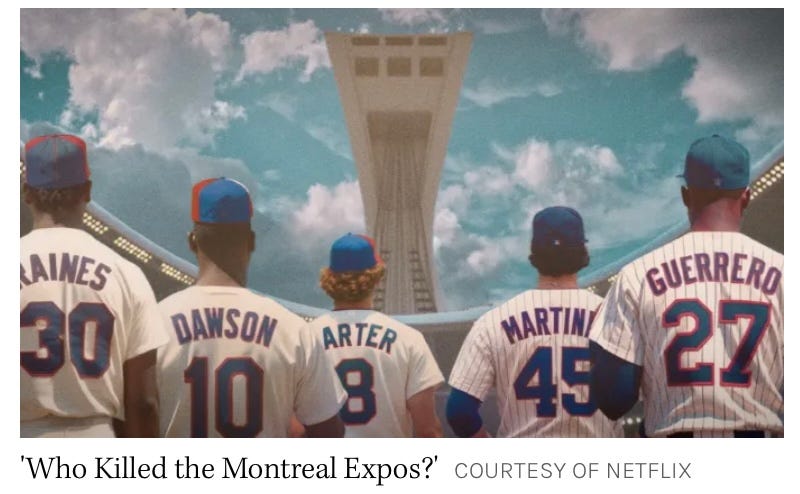
The Expos had a rabid passionate fan base, a great baseball city, and yet they could not sustain a team. They also did not have a stadium, and could not keep their homegrown players whom, by the way, included many future Hall of Famers. Gary Carter, Andre Dawson, Tim Raines, Vladimir Guerrero, Larry Walker, and even Pedro Martinez. Every single one of them had to leave to gain success elsewhere.
I’d like you to ask yourselves: besides Tom Seaver, who have the Mets developed who were future hall of famers? In over 60 years of existence, the closest they’ve come to a Craig Biggio or Jeff Bagwell type is David Wright. And Wright may have been closer to Bagwell had he stayed healthy. Not that a Bagwell type is a bad thing. (note: I’ve used two Houston Astros legends here as they came into existence at the same time as the Mets).
The point notwithstanding is that the Mets have traditionally done poorly with developing players and talent. Guess what? They’re finally doing that.
“The Comeback” featured baseball exec wunderkind Theo Epstein who had the foresight and laid the framework for a winning Red Sox franchise. In the documentary, he outlined how his dad (who was from a family of Sox fans) told him to “be bold.” Epstein then went and made some very unpopular moves. Such as trading fan favorite Nomar Garciaparra. He also brought in guys like Kevin Millar (who will never have to pay for a drink in Boston) and Hall of Famer David Ortiz, who carried the team and city on his back many times in his storied career.
The documentary didn’t entail how they also coldly let Pedro Martinez walk that offseason.
Howard Bryant - and I’m paraphrasing - said that when Boston didn’t have championships, all they had was their superstars, like Garciaparra or Martinez. But by trading “Nomah”, Bryant gave Epstein credit. “He knew what it would take to win.”
Which brings me to the theme here. Perhaps we need to take emotion out of the equation and look at what the Mets are doing as opposed to what they’re not.
When Cohen became the owner, the farm system was not in good shape, to put it mildly. Now it’s one of the top ranked in all of baseball.
Why is that? In 2023, they decided to go long on futures. Invest in their minor league talent. Cultivating talent internally. Fortifying with free agents where they can.
In doing so, they shorted their blue chips. In 2023, that was trading their “sure things,” like Max Scherzer and Justin Verlander. This year, they parted ways with Pete Alonso and Edwin Diaz. They just did not agree upon the value Alonso could currently bring over what the future return on investment could be. Diaz, admittedly, was surprising; given that he went to the Dodgers, though, it’s clear he wanted an opportunity to win rather than grow.
They’re holding onto their long term investments. Juan Soto and Francisco Lindor seem to be safe, Lindor for now at least.
On a personal level, do I like that the Mets didn’t even make a vanity offer to Alonso? Not really. But given the optics, would a hollow offer have made us feel better? After the optics of last year’s offseason, and Alonso’s public declaration that he’d opt out after the Mets were mathematically eliminated on the last day of the regular season? Sorry, but no. I can see why the Mets bowed out.
Perhaps David Stearns is taking a page from Theo Epstein’s advice to “be bold.” It takes a bold person to stick to the plan, whether it’s popular or not.
Just because an owner has a lot of money doesn’t mean they should just spend indiscriminately. Does winning in the future mean sacrificing comfort now? Perhaps.
Sticking to the plan is a tough call, but perhaps it’s the right one. It’s one that should not be surprising, nor shocking, at this point.
Nice article Taryn.
I think one thing we can all agree on is that bringing back the same team from 2025 was not going to make the Mets a championship team. I envisioned Brandon Nimmo moving from left field to first base due to the inevitable loss of Pete Alonso. This way, they would’ve kept his bat and productivity in the lineup and had less worries with his declining left field play.
We knew from the prior contract, that the Mets did not intend to pay Alonso 30+ $1 million a year for the number of years that he wanted. But not making him an offer, in my mind, is absurd. They could’ve made him a four year offer $32 million a year so that the years were shorter but the dollars still made him the highest paid first baseman. If they can pick up an outfielder who can hit 30+ home runs with a .270 average and an OPS .775 or higher, they would essentially have replaced Alonso’s production. As far as Diaz, clearly he wanted to play on a winner and who in the right mind wouldn’t wanna play for the Dodgers.
It is interesting that the opt out clauses that are in so many contracts have been viewed by the teams as a way to potentially get out of a bad contract. In reality, it provides the player with an opt out to cash in on the free agent market once again. Even Juan Soto has an opt out clause after six years, and I bet Stearns is already hoping, that is if he’s still an employee of the Mets, that Soto will opt out and they can get out from the contract.
So while I am extremely disappointed at the loss of those players, I am cautiously optimistic that Stearns will continue to tinker with the roster in bringing players who can both be more productive on the offensive side and field their position.
I do believe that all of this has sadly pushed Cohen’s five-year plan into an eight year plan. Let’s hope the great work that they have done developing their farm system will pay off with a few players coming up to the big club this year, most notably Benge and Sproat, and also be sufficient to trade for a few players to make the team better.
They are not a player or two away from a title so I don’t see a Bellinger or Tucker long term signing, nor an emptying of the farm for one year of Skubal.
My opinion is that the Mets were correct in not paying the freight for either Alonso or Diaz once they opted out of their contracts.
But, I do wonder how both the 2025 season and the offseason would have turned out if the SP were healthy. Senga was outstanding before he got hurt and Canning was better than expected. What would the Mets' season have been if those two made 25+ starts and pitched near the level they did over an entire season? What if Manaea didn't miss a whole lot more time than was expected and then pitched at a level near where he did in '24?
No team stays completely healthy. But give the Mets those three pitchers healthy and keep the injuries to Alvarez, Blackburn, Garrett, Kranick, Marte, McNeil, Megill, Minter, Montas, Nunez, Scott, Siri, Vientos and Winker.
The Mets didn't have the pitching depth to survive the injuries they had. But no team besides the Dodgers could have survived, either. Look at the Braves, a perennial playoff team. But once injuries decimated their pitching staff, they couldn't survive and they finished with a worse record than the Mets.
I get it - talking about injuries is something that most people equate with loser talk. I just don't see how you just dismiss that when talking about the '25 Mets or the '25 Braves. Were the Phillies that good or did they just stay significantly more healthy than their two main rivals?
And if the Mets make the playoffs - even if they didn't reach the NLCS again - does Diaz have a different point of view on things and accept their contract offer? And would Mets fans be so distraught if it was just Alonso leaving and not Alonso and Diaz? And does Stearns make the Nimmo trade if they're coming off back-to-back playoff seasons?
We'll never know...