
Who’s on first

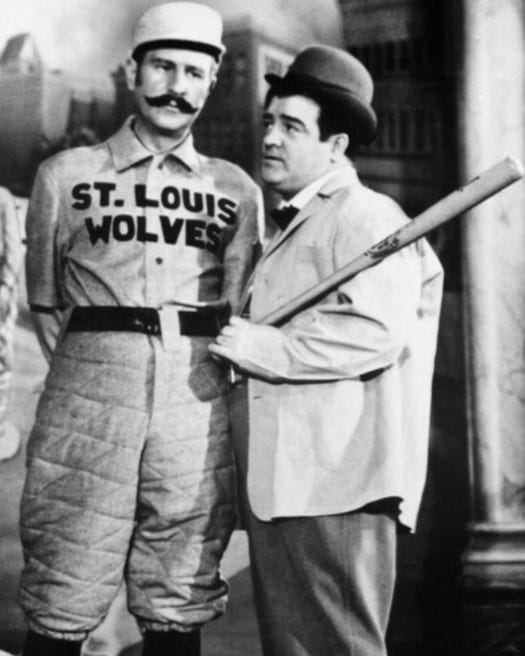
If you have never seen the famous Abbott and Costello routine, “Who’s on First,” Google it. It is a classic and no matter how many times I may have seen it, it is still funny. As you go through the entire “bit” there is so much that is applicable to the current Mets. It has taken a while but I’ve learned the names of the players on their roster, even if I could not pick most of them out of a lineup without a hint of who’s who. Can’t imagine how long it takes Yankee fans to learn their roster just from a number without a name.
But let’s go back to the theme of this blog of who’s on first. Remember that what we were all sold with all of that off-season wrangling was supposed to be a team that hit less homeruns, made better contact, would be stronger hitting with RISP, and wait, here comes the big one, would excel defensively and therefore increase the team’s chances of winning with something Stearns referred to as “run prevention.”
We said goodbye to three long-time Met favorites and hello to a 28-year-old budding star who needed to learn third base, a second baseman who can certainly field but has only started to hit the ball a third of a season in, and an over the hill and frequently injured player who needed to learn first base. Jorge Polanco became the first answer to the question who’s on first. He neither provided offense nor defense. That’s okay says management, because we have plenty of players who can play first base, as if that position is a walk in the park. We were not thinking we would get the second coming of Keith Hernadez in the offseason, but we did expect a bonafide first baseman on the roster. We are still waiting.
In 1960’s and 1970’s (the olden days) when I started watching baseball, first baseman often turned out to be outfielders who could still hit but no longer had the legs to roam the outfield. Teams simply suffered with whatever they could get as long as they could still hit. But that should not be happening anymore in this age of specialization and all those training and incubator programs to help players be all that they can be.
So, management doesn’t bring an outfielder in to play first (dare I suggest that Brandon Nimmo could have moved to first base and still given the team strong offense and the ability to play 150 plus gamers) but decides to put Mark Vientos out there because he stinks playing third base. And after all, how hard could playing first base be? Vientos, who never found his stroke after his explosive rookie season, plays a mediocre at first base, but did turn a couple of nifty double plays, which made us think that perhaps we could at least get some run prevention out of him. Nah. And what makes matters worse is that he is currently hitting .214 with an OPS of .617.
A few days ago, Locked on Mets, an interesting daily Mets blog broadcast on XM Radio, opined that when Franscisco Lindor comes back from his injury, the Mets should move Bo Bichette, an average shortstop at best, back to third base, where his experience at that position has come just this season, and install Baty at first base. This is a position he is not good at, and by the way he is hitting just .235 with an OPS of .639 with just three homeruns. That move would give the team two novices at the corner positions.
In the same breath talking about putting Baty at first, the Locked on Mets broadcast also tried to rationalize trading away Nimmo because it made room for the emergence of Carson Benge and AJ Ewing. Nice try but shut up. Let’s also not forget Jared Young, who I railed on last year for not even deserving a spot on the roster and all he has done this year so far is play adequately wherever they put him, while hitting .291 with an OPS of .884, an OBP of .375 and us currently slugging at a .509 level, ahead of everyone but Juan Soto. Young has played 28 games at first base in his career without an error. That does not make him a first baseman, but at least he is hitting.
Given all the options, he would be the answer to my question in the title of this piece and I’d let him play first until he stops hitting. I can’t possibly end this Mets360 entry without noting that Pete Alonso, the former poor fielding Met first baseman, has made just two errors in 62 games at first, a .996 fielding percentage. In fact his career fielding percentage over a 162 games season is .993. And, just to add insult to injury, he’s hitting .239 with an OPS of .758 to go along with 13 long balls and 41 RBI. He would be tied with Soto for homers and leading the team in RBI. But instead of paying him $30 million plus a year for all he could bring to this team, they instead chose to give $20 million a year for two years to Polanco.
Once they figure out who’s on first, they can then move on to second base, where Marcus Semien and the three remaining years on his contract that will pay him $72 million is hitting .236 with an OPS of .639.
Alonso has had a nosedive season offensively and we shouldn't pretend otherwise. He's had a drop of 103 points in OPS. That contract is going to end up being way worse than Polanco's bad deal.
Murakami would have been the ideal replacement given his age. Ryan O'Hearn would have been a better replacement, too. And perhaps most surprising, Luis Arraez has had a terrific season, albeit at 2B. Arraez has split time between 1B and 2B in the past.
I wonder if the Mets have learned any lessons on bargain hunting, paying two thirds the price for a 95% reduction in RBIs.